

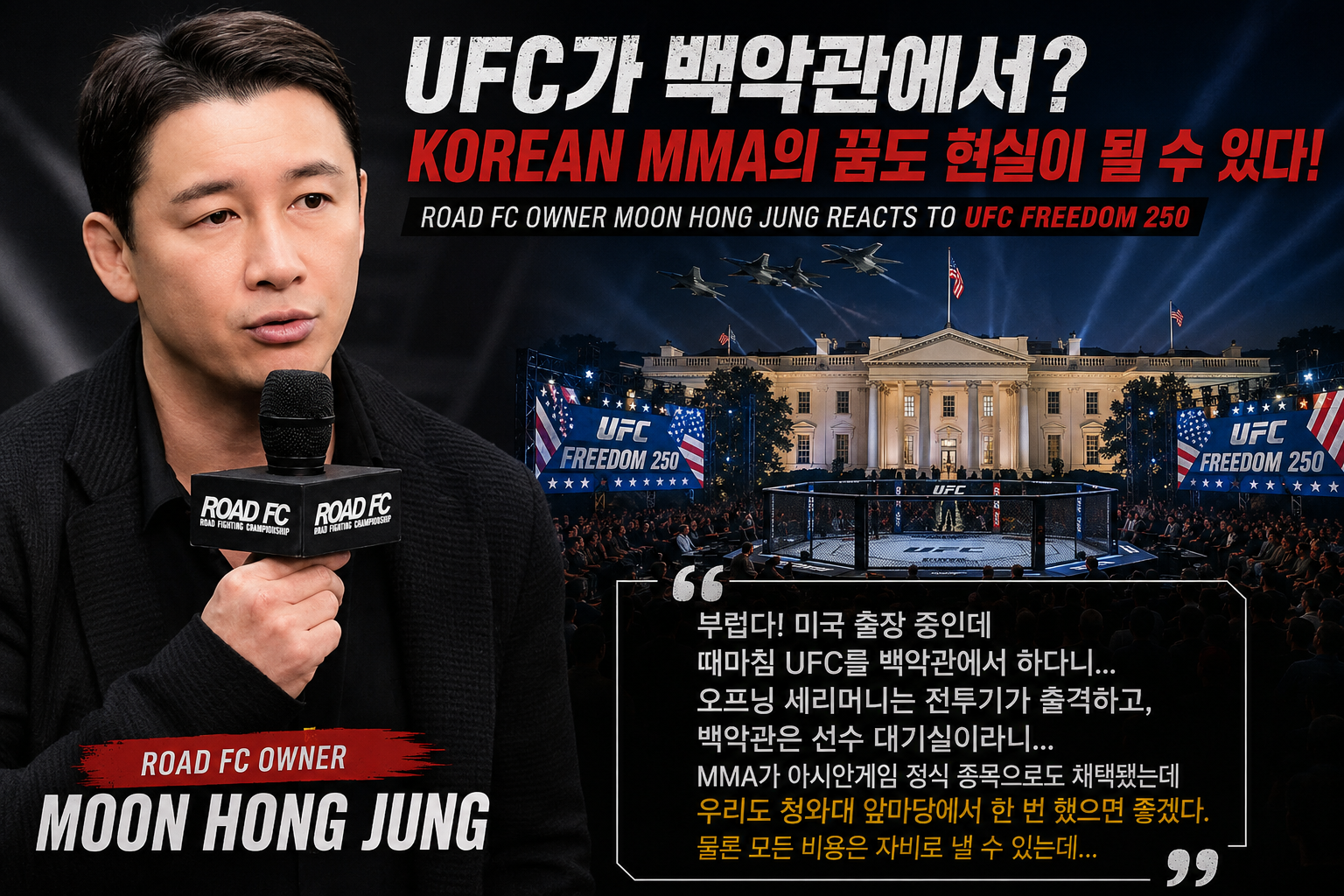
ROAD FC founder Moon Hong Jung praised UFC Freedom 250’s historic White House setting, highlighting how far MMA has come from its controversial beginnings to becoming a globally recognized mainstream sport.
The impact of UFC Freedom 250 continues to resonate far beyond the United States.
This week, ROAD FC founder and CEO Moon Hong Jung shared his thoughts on social media after learning that UFC Freedom 250 would be staged at the White House, calling attention to how dramatically mixed martial arts has evolved over the past three decades.
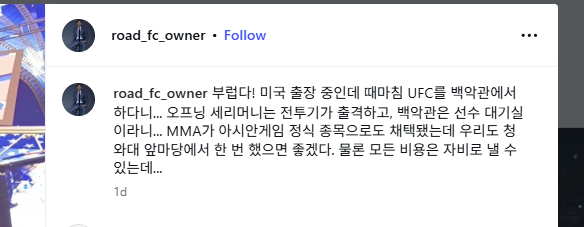
Posting on Instagram (@road_fc_owner) while traveling in the United States, Moon expressed both admiration and a touch of envy regarding the historic event.
“I’m jealous! I’m on a business trip in the United States and the UFC is holding an event at the White House. Fighter jets for the opening ceremony, and the White House serving as the fighter waiting area. MMA has already been adopted as an official event in the Asian Games. I wish we could hold an event in the front yard of the Blue House someday. Of course, I’d be willing to cover all the expenses myself.”
The comment quickly drew attention among Korean MMA fans, not only because of Moon’s stature within the sport but because it reflects a larger truth: mixed martial arts has reached a level of legitimacy and mainstream acceptance that would have seemed unimaginable just a few decades ago.
UFC Freedom 250 Represents a Historic Moment for MMA
For many observers, UFC Freedom 250 is more than just another fight card.
The event has become a symbol of how far the sport has progressed since the early days of the Ultimate Fighting Championship.
When the UFC debuted in November 1993, mixed martial arts was viewed by many politicians, media outlets, and athletic commissions as an unsafe spectacle rather than a legitimate sport.

Perhaps no critic was more influential than John McCain, who famously referred to MMA as “human cockfighting” and led a nationwide effort to restrict and ban the sport across the United States.
Throughout the late 1990s, the UFC struggled to secure television distribution, state athletic commission approval, and public acceptance. Many believed the sport would never survive.
Instead, it evolved.
Unified rules were introduced. Fighter safety standards improved. Athletic commissions began regulating events. Promoters invested in professionalism. Athletes became more well-rounded and technically skilled.
The result was the transformation of MMA from a fringe attraction into one of the fastest-growing sports in the world.
From Controversy to Mainstream Success
The journey from banned spectacle to White House event is one of the most remarkable stories in modern sports.
Today, UFC champions are household names. MMA gyms can be found in cities across the globe. Brazilian Jiu-Jitsu academies continue to grow at a rapid pace, introducing new participants to combat sports every year.
The rise of stars such as Conor McGregor helped propel MMA into mainstream culture, attracting audiences far beyond traditional fight fans. Major crossover events featuring personalities such as Jake Paul have further expanded the sport’s reach, bringing millions of new viewers into the combat sports ecosystem.
Meanwhile, social media, YouTube content, podcasts, and streaming platforms have made fighters more accessible than ever before, creating new opportunities for fan engagement and global exposure.
Korean MMA Has Grown Alongside the Sport
The growth of MMA globally has been mirrored by the development of Korean MMA.
When ROAD FC was founded in 2010, opportunities for Korean fighters were significantly more limited than they are today. Since then, South Korea has produced internationally recognized athletes, world champions, successful coaches, and thriving domestic promotions.
Organizations such as ROAD FC, Black Combat, AFC, and Z-Fight Night have helped create a sustainable domestic scene while providing platforms for fighters to develop their careers.
At the same time, Korean athletes have continued to make their mark internationally through the UFC, ONE Championship, RIZIN, and Road to UFC.
The country’s MMA infrastructure has also expanded dramatically. New gyms continue to open across Korea, while Brazilian Jiu-Jitsu participation has surged in popularity among both competitors and recreational practitioners.
MMA’s Recognition Continues to Grow
Moon Hong Jung’s reference to the Asian Games highlights another important milestone in the sport’s evolution.
Combat sports related to mixed martial arts and grappling have increasingly gained recognition through international sporting organizations. While MMA itself continues pursuing broader recognition, the inclusion of combat disciplines in major multi-sport events demonstrates how attitudes toward martial arts competition have shifted over time.
What was once dismissed as a fringe activity is now regularly discussed alongside traditional sports.
That transformation helps explain why an event like UFC Freedom 250 carries so much symbolic weight.
Could Korean MMA Have Its Own Historic Moment?
Moon’s playful suggestion about hosting a major MMA event in front of South Korea’s Blue House may have been made in jest, but it also reflects the ambition shared by many figures within Korean MMA.
As the sport continues to grow, Korea is increasingly viewed as one of Asia’s most important markets for combat sports. The country boasts passionate fans, world-class athletes, and an expanding network of gyms and promotions.
While an event of that scale may still be years away, the fact that such conversations are even taking place demonstrates how much the sport has evolved.
A Reminder of How Far MMA Has Come
For longtime fans, UFC Freedom 250 represents more than a milestone event.
It serves as a reminder of the sport’s extraordinary journey.
From being labeled “human cockfighting” in the 1990s to being celebrated at one of the most recognizable government landmarks in the world, mixed martial arts has undergone a transformation few could have predicted.
Moon Hong Jung’s reaction captured that sentiment perfectly.
For those who have dedicated their lives to building the sport, whether through promotions like ROAD FC, coaching, or competition, the success of UFC Freedom 250 isn’t just a UFC story.
It’s a victory for MMA as a whole.
And for Korean MMA, it offers another glimpse of what may be possible in the years ahead.
About The Author




Join the Conversation