

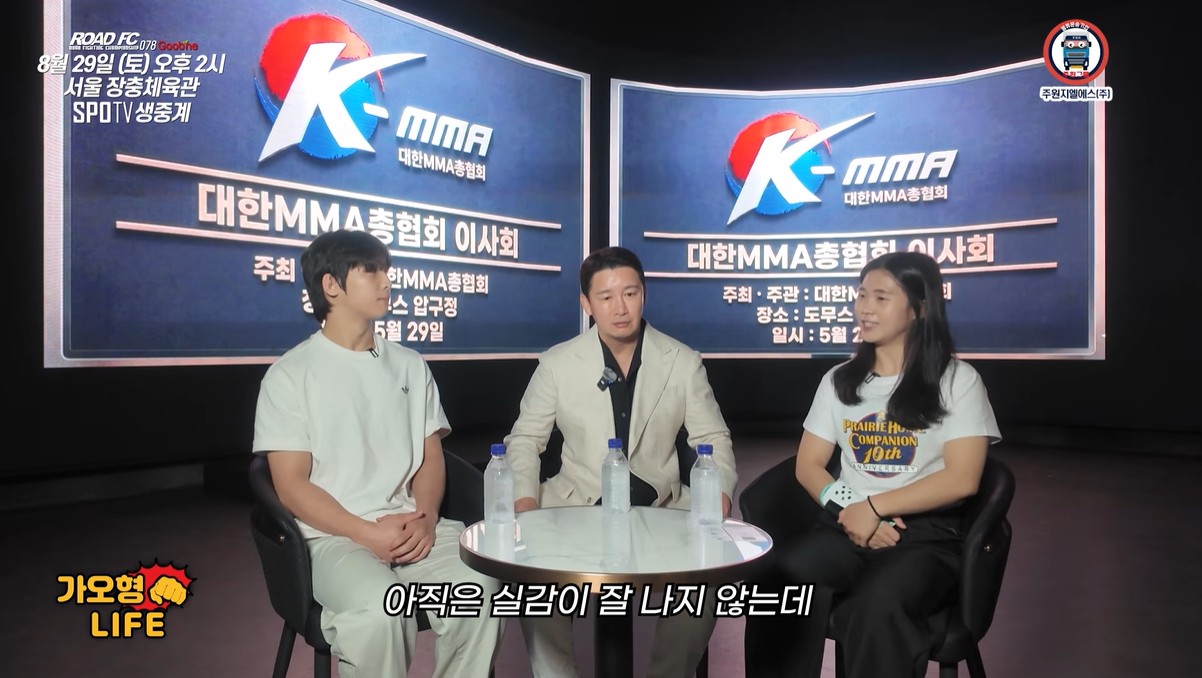
In a candid interview with Road FC CEO Moon Hong Jung, Asian Games MMA representatives Eun Seok Choi and Bomi Lee discuss the sacrifices, challenges, and responsibilities that come with representing South Korea on one of the biggest stages in combat sports.
The path to becoming an Asian Games MMA national representative is rarely visible to the public, and even less understood. For Korea’s two selected fighters, Eun Seok Choi and Bomi Lee, the journey has been shaped by years of quiet work, long stretches of uncertainty, and a determination that did not fade even when recognition seemed distant. Their recent conversation with Road FC CEO Moon Hong Jung reveals the depth of that journey and the weight of the responsibility they now carry as the only two MMA athletes representing Korea at the Asian Games.

The interview begins with a sense of disbelief from both fighters. Bomi Lee admits that she never imagined she would stand on such a stage. Even after hearing the news, the reality has not fully settled in. She describes the feeling as heavy rather than celebratory, a reminder that becoming a national representative means more than competing. It means carrying the expectations of a country. As a professional fighter she already understood the need to be careful with her actions, but now she feels that every word and every step must reflect the honor of representing Korea.

Eun Seok Choi’s story reaches back even further. He recalls the first AMMA event he attended, when he was still too young to compete. His birthday had not yet passed, and the rules required athletes to be at least eighteen. Instead of staying home, he traveled at his own expense simply to be present. He watched senior fighters compete, studied their movements, and quietly promised himself that he would one day stand where they stood. The conditions were rough, the hotel was filled with ants, and the environment was far from glamorous, yet those early experiences became the foundation of his dream.
Both fighters spent more than three years competing in AMMA events, collecting points through qualifiers and tournaments. Nothing about their selection was sudden. Nothing was handed to them. Their national team status is the result of a transparent point system recognized by the Korean Sport and Olympic Committee. Moon Hong Jung emphasizes this repeatedly, noting that the athletes earned their positions through consistent performance, not through favoritism or promotion affiliation.
During the interview, Choi reveals a moment he had kept to himself for a long time. In a previous qualifier he walked into a restroom and found several people acting as lookouts. Inside, the fighter who would later defeat him was hurriedly handling something suspicious. A syringe lay in the trash. A substance he could not identify was nearby. Choi is careful not to accuse anyone directly, but the scene left a strong impression. Moon Hong Jung explains that some countries use a system where earning a single national slot allows them to send a different athlete to the Asian Games finals. A fighter who might have used banned substances during qualifiers could be replaced by a clean athlete later, avoiding detection during the official drug testing at the Games. It is a loophole that creates frustration for clean athletes who compete with integrity.
Despite this, Choi refuses to blame anyone but himself for his losses. He acknowledges that he had opportunities to finish the fight and failed to take them. His attitude reflects a maturity that stands out, especially for someone who is still only nineteen.
The conversation shifts to the broader landscape of Asian MMA. Moon Hong Jung notes that countries in Central Asia treat combat sports with an intensity that borders on national identity. Medalists are greeted at airports by hundreds of supporters. Their success becomes a symbol of national pride. In the women’s divisions, China stands out as a dominant force. In the men’s divisions, the Central Asian nations remain overwhelming in their strength and depth.
The fighters also discuss the unique rules of AMMA competition. The scoring system rewards clean strikes more heavily than many professional fighters expect. Light jabs and touches accumulate points quickly. Wrestlers wrap only their thumbs and wrists to maximize grip. Gloves are thicker than professional gloves, making knockouts rare. Shin guards are mandatory and uncomfortable. Stepping out of bounds three times results in disqualification. Finals allow head kicks and elbows, but earlier rounds do not. It is a system that demands adaptation, and even experienced professional fighters can struggle if they do not study the rules carefully.
As the interview nears its end, both athletes address the wave of online criticism that followed their selection. Some commenters claimed that only fighters from certain promotions were chosen. Others questioned how a nineteen year old like Choi could possibly be a national representative. Both athletes express how painful these comments were, especially after years of effort that most people never saw. They emphasize that their selection is officially recognized and earned through a long point based process.
Moon Hong Jung closes the interview by reminding them that they are the only two MMA athletes representing Korea at the Asian Games. Their journey is legitimate. Their positions are earned. Their responsibility is real. And the support they will receive from Road FC and the national association will be directed toward helping them perform at their highest level when the moment arrives.
Road FC CEO, Moon Hong Jung’s interview with Eun Seok Choi and Bomi Lee full video
Full interview courtesy of Road FC CEO, Moon Hong Jung’s youtube channel:
About The Author


Join the Conversation