


Two-time Olympic gold medalist Kwon Ho Shim watches Islam Makhachev’s wrestling up close and sees the details that help explain why the UFC champion is so difficult to stop.
There are plenty of people qualified to analyze Islam Makhachev’s wrestling.
Kwon Ho Shim brings a different level of credibility.
The South Korean Greco-Roman wrestling legend won Olympic gold at the 1996 Atlanta Games at 48 kg before moving up and doing it again at the 2000 Sydney Olympics at 54 kg. He was also a two-time world champion, winning gold in 1995 and 1998.
So when Dong Hyun Kim invited Shim to sit down and watch Makhachev wrestle, the appeal was obvious.
Rather than simply seeing takedowns, cage control and top pressure, what would one of the greatest wrestlers in Korean history notice?
As it turned out, quite a lot.
An Olympic Champion Watches Makhachev
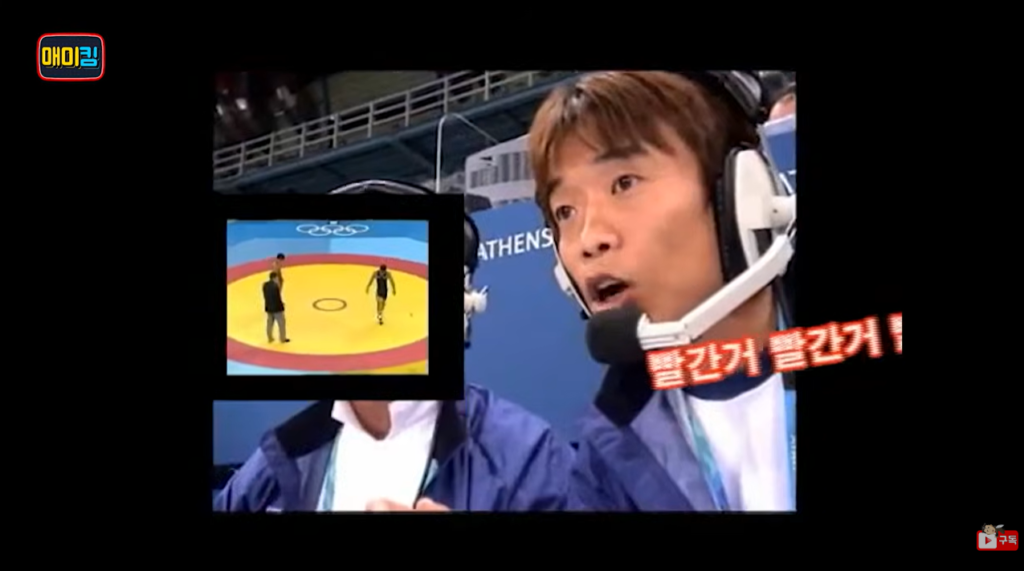
Dong Hyun Kim introduces Kwon Ho Shim as a wrestling legend who can see things in Makhachev’s game that most MMA viewers—and even experienced fighters—might overlook.
Shim’s résumé makes that more than hype. He captured major international titles across two weight divisions, including Olympic, World Championship, Asian Games and Asian Championship gold.
Joining them for the watch-along were UFC welterweight Seok Hyeon Ko and MMA commentator Cha Do Reu, giving the conversation perspectives from elite wrestling, active UFC competition and MMA analysis.
Once the action begins, however, Shim quickly starts seeing the fight through a wrestler’s eyes.
Shim Starts Calling the Wrestling Before It Happens
One of the most fascinating moments comes during an early grappling exchange.
Kwon Ho Shim begins calling for an adjustment to the arm position.
“Switch the arm,” he says repeatedly.
Seconds later, the adjustment happens.
The others immediately react, joking that it almost looks as though Makhachev can hear Shim talking from the room.
But Shim is watching something more subtle than the eventual movement. He notices how Makhachev is using his body to prevent his opponent from freely making that adjustment in the first place.
Shim also sees a difference between knowing a wrestling defense and having that defense completely ingrained into a fighter’s instincts.
The reactions are there, but to someone who spent his career competing at the highest level of international wrestling, the difference is visible.
It’s an early example of what makes Shim’s commentary so interesting.
He isn’t impressed simply because Makhachev can take someone down.
He’s watching how Makhachev controls the positions between the obvious techniques.
Why Islam Makhachev Doesn’t Get as Tired as You Think
The conversation soon turns toward one of the biggest misconceptions surrounding Makhachev’s style.
When a fighter spends long periods wrestling against the cage, it can appear that he’s exhausting himself trying to secure the takedown.
Shim doesn’t necessarily see it that way.
From certain positions, Makhachev can maintain pressure and control with relatively small movements. The defending fighter, meanwhile, may be working significantly harder just to remain standing, regain position or create enough space to escape.
Shim even jokes that you could leave and come back and potentially find them in essentially the same position.
But there is a serious point behind it.
Waiting for Makhachev to simply exhaust himself may be a mistake.
“You can’t expect a champion-level fighter to get tired,” Shim explains in essence. At that level, the opponent has to create his own opportunities rather than relying on fatigue to eventually solve the problem.
Later, Shim returns to the same principle. Being underneath or trapped against pressure can require considerably more energy than maintaining the controlling position.
The person who looks like he’s doing less may actually be winning the energy battle.
Islam Makhachev Is Wrestling for 25 Minutes

Shim also recognizes something important about Makhachev’s pacing.
Not every wrestling exchange needs to produce a takedown.
Not every dominant position needs to produce a finish.
And not every minute needs to be won 10-0.
The group discusses how Makhachev appears comfortable doing only as much work as necessary because he understands that the fight could last five rounds.
If he forces a takedown at maximum intensity every time he touches his opponent, he risks burning energy he may need later.
Instead, Makhachev can pressure, control and wait.
Shim relates it to his own competitive mentality. If you’re thinking about winning a decision, there are moments when you don’t need to force the action immediately. You can allow part of the round to develop before securing the meaningful position that separates you on the scorecards.
A narrow victory still counts as a victory.
Makhachev appears to understand that perfectly.
The Wrestling Isn’t Just About Takedowns
That distinction is important because Makhachev’s effectiveness can sometimes be reduced to one simple explanation:
He’s an elite wrestler.
Shim’s analysis suggests something more complicated.
What stands out isn’t only Makhachev’s ability to finish a takedown. It’s his understanding of when he needs the takedown, how much energy he should spend pursuing it, what position he needs afterward and how he can make the opponent work while conserving his own energy.
In other words, Makhachev isn’t wrestling simply to prove that he can wrestle.
He’s wrestling to win an MMA fight.
Dong Hyun Kim and the rest of the group begin recognizing the same thing as the rounds progress.
Makhachev repeatedly seems to answer the question opponents pose before facing him:
Can he really take this guy down?
Seok Hyeon Ko compares it to watching Georges St-Pierre. Fighters would appear to have the tools to stop GSP’s wrestling, yet he repeatedly found a way to put them on the mat anyway.
Makhachev creates a similar feeling.
“Champion,” comes the reaction.
“He’s a champion.”
Moving Up Doesn’t Necessarily Mean Losing the Wrestling Advantage
Shim also offers an interesting explanation for why an elite fighter moving up in weight can remain so effective.
His perspective is particularly meaningful considering his own career.
Shim won his first Olympic gold medal at 48 kg in Atlanta before the division was eliminated internationally. He then moved to 54 kg and eventually captured another Olympic title in Sydney.
According to Shim, athletes coming from lighter divisions often arrive with technical advantages developed against faster opponents.
Lower weight classes can demand greater speed and rapid technical transitions. Larger divisions can place relatively more emphasis on size and strength.
A fighter moving upward doesn’t suddenly forget the speed and technique developed below.
That can create problems for naturally larger opponents who aren’t accustomed to dealing with those transitions.
“Try always training with slow people and then suddenly meeting someone fast,” Shim says in explaining the difference.
Shim knows something about making that transition successfully.
So does Makhachev.
Shim Predicts Makhachev’s Next Move
As the fight progresses, Shim’s commentary becomes almost predictive.
With the clock becoming increasingly important, he begins anticipating when Makhachev will make his next serious wrestling attack.
His reasoning isn’t based solely on technique.
It’s based on the score.
If Makhachev believes he’s ahead, Shim doesn’t expect him to recklessly expend energy looking for a finish. He expects him to create enough offense to reinforce his advantage, establish control and make it increasingly difficult for his opponent to produce the dramatic moment needed to change the fight.
Then Makhachev shoots.
Shim immediately begins explaining the hand positioning.
Once Makhachev establishes the position, Shim doesn’t expect him to waste unnecessary energy anymore.
He’s already playing a winning game.
“It’s a game he’s winning,” Shim explains.
From there, Makhachev can appear to attack while continuing to manage the clock and position.
It’s one of the best sequences in the entire watch-along because it demonstrates that Shim isn’t merely reacting to what happened.
He’s understanding why Makhachev is choosing to do it at that particular moment.
Kwon Ho Shim Gives Makhachev His Approval
Eventually, Dong Hyun Kim asks the question the entire video has been building toward.
This was one of Shim’s first opportunities to properly sit down and study Makhachev.
He has now watched the wrestling.
What does he think?
Kim asks whether Makhachev is the best among the UFC fighters Shim has watched with them.
Shim’s response is simple.
“Yes.”
Coming from a two-time Olympic champion and United World Wrestling Hall of Famer, it’s quite an endorsement.
But perhaps the more interesting part is why Shim is impressed.
It isn’t one explosive double-leg.
It isn’t overwhelming athleticism.
It isn’t even one particular technique.
It’s the completeness of Makhachev’s wrestling intelligence.
Seok Hyeon Ko Sees a Blueprint
The conversation then turns toward someone sitting in the room who could potentially benefit directly from what they’re watching.
Seok Hyeon Ko.
The UFC welterweight is himself a wrestling-heavy fighter, and watching Makhachev gives Ko a glimpse of what that style looks like when refined at the highest level of MMA.
Ko says Makhachev is the kind of fighter he needs to study. There are elements he believes he can copy, adapt and incorporate as he continues developing his own game.
Shim’s advice is fittingly old-school.
Train with stronger people.
Shim explains that he frequently trained with wrestlers one or even two divisions above him. Constantly working with people you can physically dominate doesn’t prepare you for the strength and resistance waiting at the highest level.
If Ko wants to chase someone like Makhachev, Shim believes he needs rounds with athletes possessing comparable strength, conditioning and wrestling ability.
“You have to train with those kinds of people to catch up,” Shim says.
A Champion Recognizes a Champion
By the end of the watch-along, Makhachev has turned one of Korea’s greatest wrestlers into a believer.
And that may be the most interesting endorsement of all.
Kwon Ho Shim knows what elite wrestling looks like because he lived at its highest level. He won Olympic gold in two different weight classes and twice stood atop the World Championships.
Yet what catches his attention about Makhachev isn’t simply wrestling technique.
It’s everything surrounding it.
The hand fighting. The pressure. The positioning. The ability to make an opponent work. The conservation of energy. The awareness of the clock. The understanding of when to attack and when doing less is actually the smarter decision.
Dong Hyun Kim and the fighters around him see an elite UFC champion.
Kwon Ho Shim sees the wrestling underneath it.
And after watching closely, the Korean Olympic legend’s verdict is difficult to misunderstand:
Islam Makhachev is the real thing.
Follow HanPunch for the latest Korean MMA news, exclusive fighter interviews, event coverage, and the stories shaping combat sports across Asia.
About The Author







Join the Conversation