

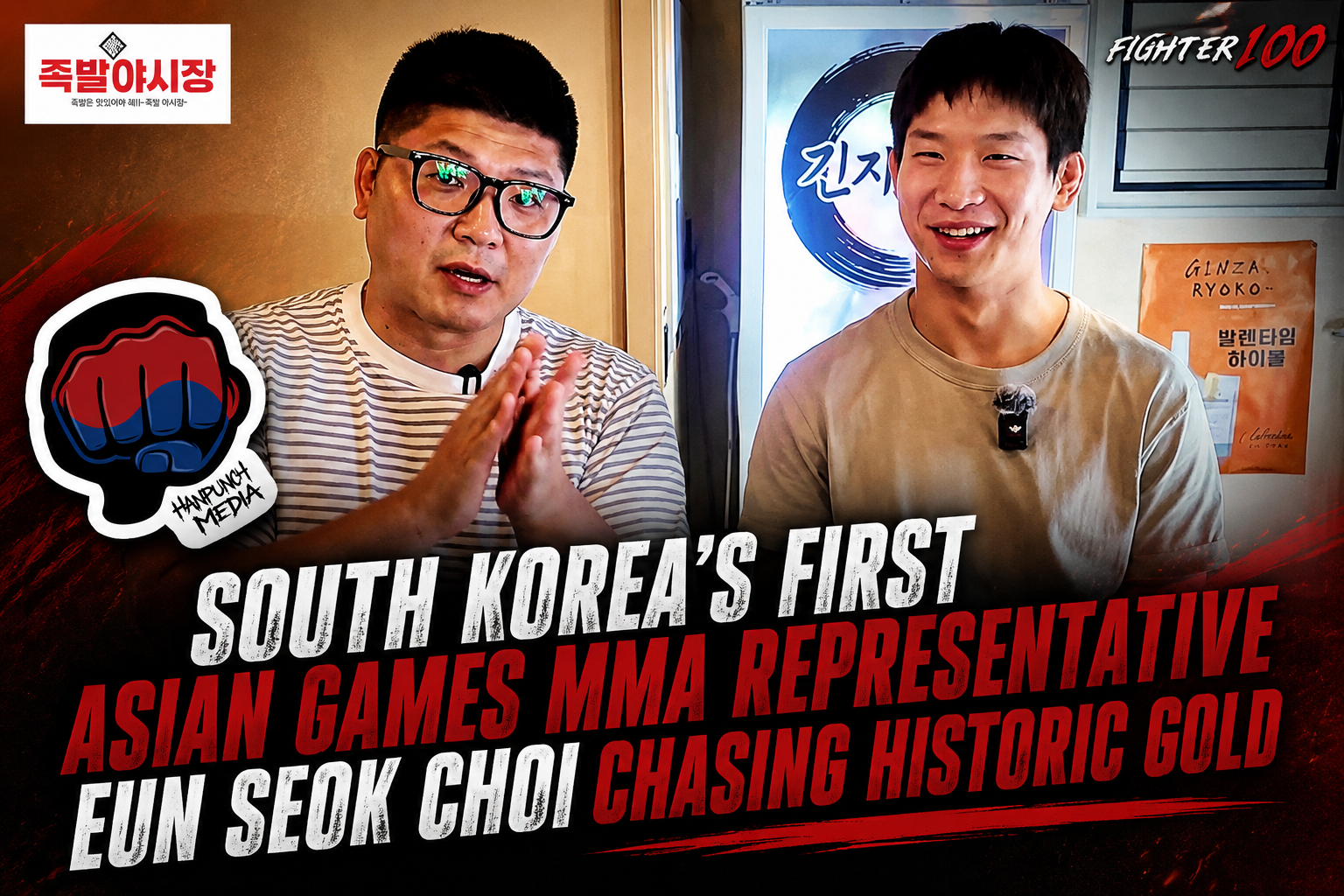
The newly selected national team member, Eun Seok Choi, discusses representing South Korea, adapting to the Asian Games ruleset, and his dream of hearing the Korean national anthem after winning MMA’s first Asian Games gold medal.
For most mixed martial artists, the dream is to compete in organizations such as the UFC, ONE Championship or ROAD FC.
For Eun Seok Choi, that dream has expanded to something even bigger.
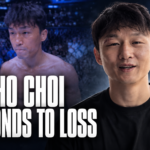
The young South Korean has earned selection as one of the country’s first national team representatives for mixed martial arts at the Asian Games, a historic milestone following MMA’s inclusion on the continental stage. In a recent interview on former ROAD FC lightweight champion A Sol Kwon’s official YouTube channel, Choi reflected on his unlikely journey, his preparation for the Games and the responsibility of representing South Korea during one of the sport’s most significant moments.
“I Never Thought I’d Compete at the Asian Games”

When asked what it meant to become one of South Korea’s first MMA national team athletes, Choi admitted that the achievement still has not fully sunk in.
“When I started training in mixed martial arts, I never imagined I would one day compete at the Asian Games,” Choi explained. “I kept working hard, and now I have been given the opportunity to stand on such a huge stage.”
Although he has represented Korea at the Asian MMA Championships before, Eun Seok Choi said competing at the Asian Games carries an entirely different level of prestige.
He believes the reality of becoming a national team athlete may only fully register when he boards the flight in September, joins the rest of Team Korea and participates in the traditional national delegation ceremonies.
A Journey Years in the Making
Choi’s path to the national team began long before the Asian Games became a realistic possibility.
As a high school senior, he traveled to the Asian MMA Championships because he wanted to observe the strongest amateur fighters in the region and understand how his own skills compared with the international level.
At the time, Choi was not old enough to compete. He paid his own expenses and attended simply to watch the tournament and absorb the experience.
Rather than becoming discouraged, the trip strengthened his desire to return.
By the second and third editions of the competition, Choi believed he had developed enough to compete with the athletes he had once watched from outside the competition area. He later secured a bronze medal at the Asian Championships, a result that helped place him in position to represent South Korea at the Asian Games.
One Goal: Hear Korea’s National Anthem
Perhaps the most memorable moment of the interview came when Eun Seok Choi described his biggest motivation.
Throughout his appearances at Asian-level championships, he watched athletes from other countries stand atop the podium while their national anthems played during medal ceremonies.
South Korea had not yet experienced that moment in international amateur MMA.
“At the Asian Championships, I heard the national anthems of other countries, but Korea’s anthem was never played,” Choi said. “I hope I can win at the Asian Games so that our national anthem will finally be heard.”
Rather than focusing primarily on individual recognition, Choi made it clear that representing his country and producing a historic result for Korean MMA remain at the center of his ambitions.
More Than a Gold Medal Is on the Line
Winning gold at the Asian Games would carry significance beyond the medal itself.
During the interview, A Sol Kwon discussed the incentives connected to a championship performance, including financial rewards and the military service benefits that may be available to qualifying South Korean medalists.
Choi acknowledged that the additional rewards provide motivation, but his response also reflected the seriousness with which he is approaching the opportunity.
“I think I have to put my entire soul into it,” Choi said.
With only a few months remaining before the Games, he intends to make every part of his training count.
Preparing for a Different Version of MMA
One of the most informative parts of the interview centered on the differences between professional MMA and the rules used in international amateur competition.
Eun Seok Choi explained that the Asian Games format requires significant technical and strategic adjustments.
Professional fighters are accustomed to competing inside a cage, often without shirts or additional protective equipment. International amateur MMA, however, can take place on an open mat while athletes wear uniforms and shin guards.
Those differences can substantially affect grappling exchanges.
Sweat normally makes it easier for fighters to escape certain takedowns and control positions. Clothing and protective equipment can reduce that effect, allowing wrestling-focused competitors to maintain grips and positions more effectively.
Choi also noted that the scoring system may reward actions differently than professional MMA.
Professional competition often places a heavy emphasis on clearly damaging strikes and decisive takedowns. Under the amateur international system, a fighter may gain an important advantage through an additional takedown, a brief positional exchange or a smaller scoring action that would carry less significance in a professional bout.
According to Choi, many of the athletes competing at the Asian level operate within a relatively narrow skill range. The difference between winning and losing may come down to which fighter understands the rules better and produces one more meaningful scoring action.
Lessons From Previous Defeats
Eun Seok Choi openly discussed the difficulties he encountered during earlier Asian Championship appearances.
During one tournament, he was controlled in a crucifix position and struggled to create meaningful offense. That experience forced him to reconsider how he could become more aggressive and make opponents uncomfortable under the amateur ruleset.
He also learned that many wrestling-oriented competitors prepare specifically to secure takedowns rather than engage in extended striking exchanges.
Some even adjust the way they wrap their hands to prioritize grappling and control.
Those experiences have shaped Choi’s approach to the Asian Games. Rather than waiting until opponents establish their wrestling, he wants to develop tools that stop takedown attempts before they become dangerous.
“If they get their hands on me, I am already at a disadvantage,” Choi explained.
His preparation will therefore focus heavily on distance management, takedown prevention and denying opponents the type of prolonged grappling exchanges that often influence amateur scoring.
Understanding the Asian Games Format
The competition format also requires careful preparation.
According to the interview, preliminary bouts are scheduled for two three-minute rounds, while the final consists of two five-minute rounds. Elbows and knees are only permitted in the championship match.
That creates another strategic challenge.
A fighter must first navigate shorter bouts in which every scoring exchange carries increased importance before adjusting to a longer and more open ruleset in the final.
Choi and his team will need to prepare for both versions of the competition rather than approaching the tournament with a single strategy.
A New Haircut and a Fresh Mindset
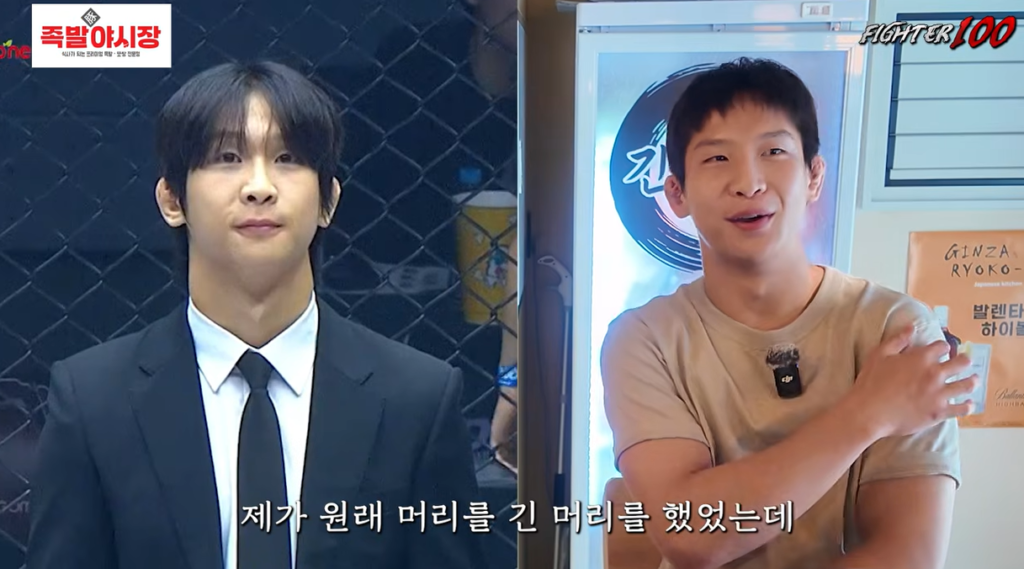
Eun Seok Choi revealed that he recently cut his long hair as a symbolic reset ahead of the Asian Games.
He described the decision as part of recommitting himself to training and approaching the coming months with a more disciplined mindset.
The change may appear minor, but for Choi it represents the beginning of the most important preparation period of his career.
He also thanked the Korea MMA Association for supporting him during the Asian Championships and throughout the build toward the Asian Games.
Choi said that support has helped create an environment in which he can concentrate more fully on representing the national team.
A Historic Opportunity for Korean MMA
The significance of Choi’s selection extends beyond his own career.
MMA’s arrival at the Asian Games represents an important moment for the sport across the continent. Choi, alongside fellow South Korean representative Bo Mi Lee, now has an opportunity to establish the first chapter of Korea’s Asian Games MMA history.
A Sol Kwon closed the interview by encouraging fans to support Choi, Lee and every South Korean athlete competing at the Games.
He also expressed hope that MMA’s inclusion could help renew public interest in the Asian Games and give Korean combat sports fans another reason to support the national delegation.
For Eun Seok Choi, becoming one of South Korea’s first Asian Games MMA representatives is already a historic achievement.
But qualification alone is not the final goal.
Choi wants to become the first South Korean athlete to win Asian Games MMA gold and stand atop the podium as the Korean national anthem plays for the first time in the sport’s continental history.
Full video available, courtesy of A Sol Kwon’s Youtube Channel (Fighter 100)
Follow HanPunch for the latest Korean MMA news, exclusive fighter interviews, event coverage, and the stories shaping combat sports across Asia.
About The Author


Join the Conversation