

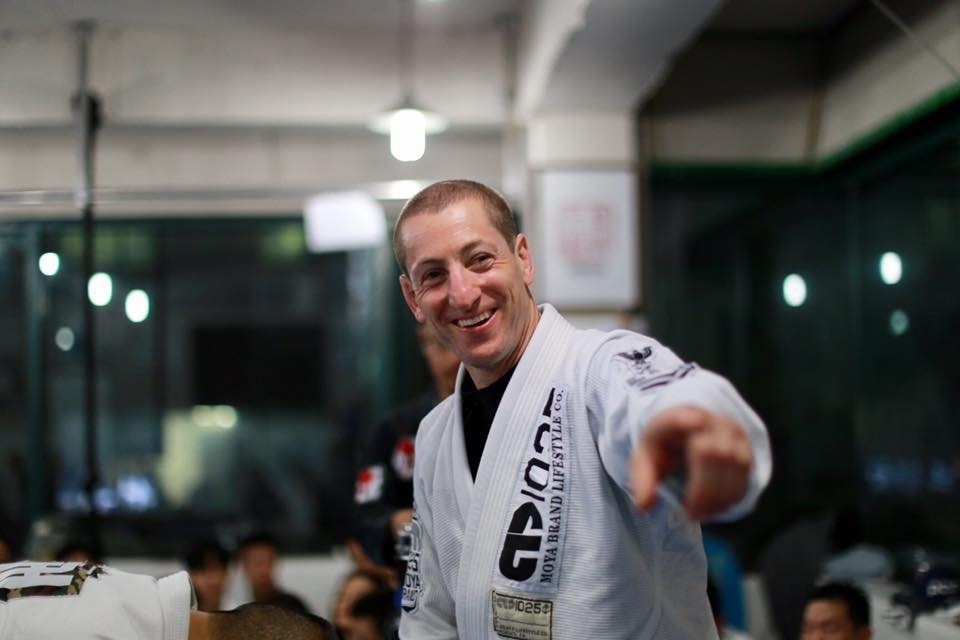
If you walk into almost any Brazilian Jiu Jitsu academy in South Korea today, you will see a familiar pattern. The instructors know his name. The black belts know his story. The students may not know every detail, but they know that someone brought this art to Korea long before it was popular. That someone is Professor John Frankl, a scholar from Los Angeles who arrived in Korea as a young student and ended up becoming the central figure in the rise of Brazilian Jiu Jitsu across the country.
Frankl was born on April 29, 1967 in Los Angeles. His interest in martial arts appeared early. At six years old he begged his parents to let him train at a local academy. The program was designed to push long contracts, so his parents pulled him out after a week, but the desire stayed with him. When he turned twelve, he began training Karate under Ron Williams. Williams focused on sparring rather than memorizing forms, and that practical approach shaped Frankl’s understanding of what martial arts should be. By the time he finished high school, he had earned his brown belt.
College brought new opportunities. While studying at UC Berkeley, Frankl discovered Kuk Sool Won and began training under Byung in Lee in San Francisco. His background in swimming and water polo helped him progress quickly. Lee awarded him a second degree black belt before returning to Korea. This was Frankl’s first real exposure to grappling, even if it came in a stylized format. After Lee left, Frankl continued exploring other disciplines. He trained Serrada Eskrima, Muay Thai, and later Thai Boxing during his time in Asia. He was not searching for belts. He was searching for something that felt complete.
In 1989, everything changed. After finishing a year abroad in Korea, Frankl stopped in Hawaii to visit his friend Glenn Uesugi. Glenn had been training Gracie Jiu Jitsu under Relson Gracie and insisted that Frankl try it. Frankl asked for a friendly test. Within minutes he realized that this was the martial art he had been looking for. The efficiency, the leverage, the control, the ability to neutralize strength with technique. It was a revelation.
He returned to Korea and immediately began practicing with a small group of friends in Seoul. They studied tapes, experimented with positions, and tried to understand this new art. One of those early partners, Robert Brown, would later join Frankl at Rickson Gracie’s academy and eventually become a black belt himself. These informal sessions were the earliest roots of Brazilian Jiu Jitsu in Korea.
In 1994 Frankl moved to Los Angeles and trained directly under Rickson Gracie at the Inosanto Academy. He earned his blue belt there before relocating to Boston for doctoral studies. In Boston he continued training under Roberto Maia, a Gracie Barra black belt and cousin to Renzo Gracie and the Machado brothers. Maia awarded Frankl his purple, brown, and black belts. By 2002 Frankl had become one of the earliest American black belts in the art.
The real turning point for Korean Jiu Jitsu came in 1999. Frankl returned to Korea to work on his doctoral dissertation. There were no Jiu Jitsu gyms. No instructors. No training partners. So he did the only thing he could. He started teaching. His first class had one student, Steven Capener, who would later become his first black belt. That small club, created simply so Frankl could keep training, became the birthplace of Brazilian Jiu Jitsu in South Korea.
From 2000 to 2004, Frankl traveled between Korea and the United States, teaching seminars and guiding the development of his early students. In 2003 he met Matt Thornton, the founder of Straight Blast Gym International. They shared a similar philosophy about training and learning, and Frankl joined SBG soon after. He became the organization’s director for East Asia and returned to Korea permanently in 2004. Two years later he opened his own academy, which eventually expanded into multiple locations and a network of more than fifty affiliated schools across the country. Today, his students operate more than one hundred academies nationwide.
Frankl’s academic life has always run parallel to his martial arts journey. He first came to Korea in 1987 as a university student. He returned in 1988 for an exchange program between UC Berkeley and Yonsei University. In 1990 he returned again to pursue a master’s degree in Korean literature at Yonsei. After completing his master’s program, he began his doctoral studies at Harvard. He earned his PhD in 2003 and joined Yonsei University’s Underwood International College in 2005, where he continues to teach Korean literature.

His story reached mainstream audiences through his appearance on the television program You Quiz on the Block. He shared how Jiu Jitsu first spread in Korea and how his early club grew into a nationwide movement. He explained that in 1999, as a brown belt working on his thesis, he simply needed training partners. That small group eventually grew into a community that now includes national level coaches and competitors. Many of his students lead major academies and represent Korea in international competitions.
Today, Professor John Frankl stands as the pioneer of Brazilian Jiu Jitsu in Korea. He is a fourth degree black belt, the highest ranking practitioner in the country, and a teacher whose influence shaped an entire generation. His legacy is not only in the belts he has awarded but in the culture he built, the community he nurtured, and the movement he sparked long before anyone knew what Jiu Jitsu would become in Korea.
You can find the full “You Quiz on the Block” episode featuring Professor John Frankl on You Quiz on the Block’s channel:
About The Author







1 Comment