

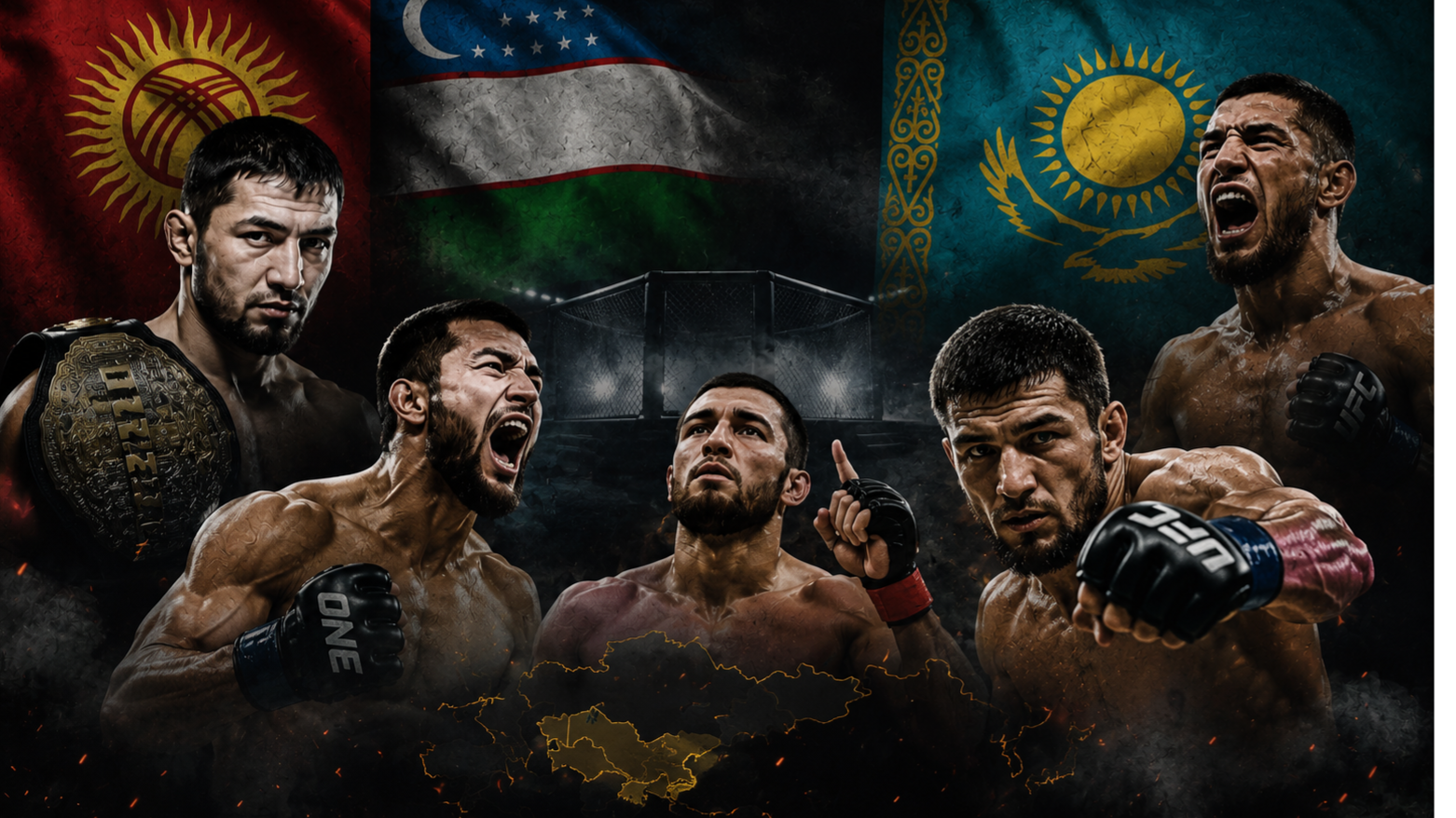
For years, Central Asia was better known in combat sports for wrestling, judo, sambo, boxing and traditional striking disciplines than for producing elite mixed martial artists. That is changing rapidly.
In 2026, fighters from Kyrgyzstan, Uzbekistan and Kazakhstan are appearing across the biggest MMA promotions in the world, while regional organizations are increasingly using Central Asia as a destination for major events and talent recruitment.
The most striking example is Kyrgyzstan. The country is no longer represented by one or two standout names. A new generation is now holding titles, competing in the UFC and ONE Championship, and challenging established fighters across RIZIN, ACA and BRAVE CF.
And the story extends well beyond Kyrgyzstan. Uzbekistan has produced a rapidly growing group of fighters in ONE Championship, including its first ONE MMA world champion, while Kazakhstan continues to provide a deep pool of fighters for international promotions.
Kyrgyzstan’s remarkable new generation
The clearest evidence of Central Asia’s emergence can be found in Kyrgyzstan.
The country already had established stars in Valentina Shevchenko and Rafael Fiziev, but the next generation is beginning to look considerably deeper.
Razhabali Shaidullaev is one of the most prominent examples. The undefeated featherweight has built a 19-0 record and captured the RIZIN featherweight championship. He is now scheduled for a major cross-promotional fight against PFL representative AJ McKee, putting a Kyrgyz fighter at the center of one of MMA’s most interesting international matchups.
Then there is Akbar Abdullaev, another undefeated Kyrgyz fighter whose rise has been particularly spectacular. The 28-year-old is 13-0 and has finished every professional opponent. His ONE Championship run includes five straight finishes, and his next major opportunity could take him directly toward the UFC.
Abdullaev is scheduled to compete on Dana White’s Contender Series on September 15, where he will face Anthony Figueroa with a UFC contract potentially at stake.
That is a significant development. Abdullaev would not simply be another Central Asian fighter entering the UFC. He would represent an increasingly common pathway: regional success → major Asian promotion → international recognition → UFC opportunity.
Kyrgyzstan already has another UFC representative in Myktybek Orolbai, a welterweight whose UFC profile lists multiple knockout and submission victories and nine first-round finishes.
The depth doesn’t stop there. Zhaksylyk Myrzabekov has emerged as an ACA interim welterweight champion, while Edil Esengulov, Kubanychbek Abdisalam and other Kyrgyz fighters have established themselves across major promotions.
That spread is important. This isn’t one exceptional fighter carrying an entire country’s MMA scene.
Uzbekistan has arrived too
If Kyrgyzstan represents the depth of Central Asia’s emerging MMA scene, Uzbekistan may be its fastest-growing force.
ONE Championship itself highlighted the country’s rise in June 2026, describing Uzbekistan as one of the world’s most exciting martial-arts hotbeds and specifically identifying Sanzhar Zakirov, Avazbek Kholmirzaev and Aslamjon Ortikov as three fighters leading the country’s current MMA surge.
Kholmirzaev has already made history.
The 25-year-old became Uzbekistan’s first ONE MMA world champion when he defeated Yuya Wakamatsu by second-round knockout at ONE SAMURAI 1 in April. His return home was met with a hero’s welcome, illustrating how quickly MMA has become a source of national sporting pride.
The UFC is also increasingly connected to Uzbekistan. Nursulton Ruziboev is an established Uzbekistani UFC middleweight, while Bogdan Guskov became the first fighter from Uzbekistan to headline a UFC event when he faced Magomed Ankalaev in Abu Dhabi in July 2026. UFC’s own coverage described Guskov as one of three active Uzbek fighters on its roster at the time.
That gives Uzbekistan representation at the very top of MMA’s promotional pyramid.
Kazakhstan provides the infrastructure and depth
Kazakhstan’s contribution to Central Asian MMA is slightly different.
The country has a long combat-sports tradition and an established domestic scene, while international promotions have repeatedly returned to the country to scout and showcase fighters.
BRAVE Combat Federation has made Kazakhstan an important stop on its global calendar. BRAVE CF 105 took place in Almaty in May 2026, marking the promotion’s fourth event in Kazakhstan. BRAVE has described Kazakhstan as a key destination because of the country’s established MMA talent pool.
Kazakhstan also has fighters moving through the major international system. UFC light heavyweight Diyar Nurgozhay is one example, while ONE’s roster includes multiple Kazakh athletes such as Samat Mamedov and Dias Otegen.
The region’s combat-sports ecosystem is built on wrestling, sambo, judo, boxing and other disciplines. That foundation provides young athletes with competitive experience long before they enter an MMA cage.
Why is Central Asia producing so many fighters?
Wrestling and grappling culture is probably the biggest factor. Wrestling has deep roots across Central Asia, giving fighters a foundation in takedowns, physical conditioning, balance and positional control.
Sambo has also played an important role. Kyrgyzstan’s sambo development dates back to the Soviet era, with the sport becoming established through clubs and sporting societies from the 1960s onward.
But the modern generation is increasingly combining those traditional strengths with sophisticated striking and MMA-specific training. The result is a fighter who can dictate where a fight takes place.
Promotions are coming to Central Asia
Perhaps the biggest sign that the region’s development is sustainable is that the promotions themselves are investing in it.
BRAVE CF has repeatedly staged events in Kazakhstan and Uzbekistan and has previously visited Kyrgyzstan. The organization has explicitly described Central Asia as an important part of its international strategy.
ONE Championship has gone even further by developing young fighters through its ONE Friday Fights system. The promotion has become an important gateway for Asian and Central Asian fighters looking to move from regional competition to lucrative international contracts. Uzbekistan’s current generation is a particularly strong example of that pathway.
In May 2026, Bishkek hosted a major MMA fan event featuring Shevchenko, Orolbai and Uran Satybaldyev alongside fighters from ONE, RIZIN, ACA, BRAVE CF, Octagon FC, JCK, XFC, CFFC and ROAD FC. The gathering specifically focused on the development of MMA in Kyrgyzstan and opportunities for young fighters.
That matters because a talent factory needs more than talented athletes. It needs coaches, gyms, promoters, competition and pathways to international opportunities.
Central Asia is gradually building all of them.
The next MMA powerhouse?
It may still be too early to call Central Asia the next dominant region in MMA.
Kyrgyzstan has fighters competing for titles across RIZIN, ONE, ACA and BRAVE while maintaining UFC representation. Uzbekistan has produced its first ONE MMA world champion and continues to expand its UFC presence. Kazakhstan remains a major regional hub for international promotions and continues to develop fighters for the global market.
The most exciting part may be that this generation is still relatively young.
If the current pipeline continues to develop, Central Asia could soon move from being a region that produces individual MMA stars to one that consistently produces champions across multiple major promotions.
And that makes fighters such as Razhabali Shaidullaev, Akbar Abdullaev, Avazbek Kholmirzaev, Myktybek Orolbai and the next wave behind them worth watching very closely.
Your home for Korean MMA news, UFC updates and fighter features. Follow HanPunch.
About The Author



Join the Conversation