

Table of Contents
Chinese MMA had a busy night on September 19, with JCK Fight Night 123 taking place in Lüliang, Shanxi, while the Happy Elephant Champions League staged another domestic card in Nanjing, Jiangsu. The two events offered a useful snapshot of the depth developing across China’s regional MMA scene.
JCK 123 stood out for its international matchmaking, bringing Chinese fighters together with opponents from countries including Nepal, Brazil, Russia, South Korea, Iran, Kazakhstan, Japan, Uzbekistan and Mongolia. The Champions League, meanwhile, focused primarily on domestic matchups.
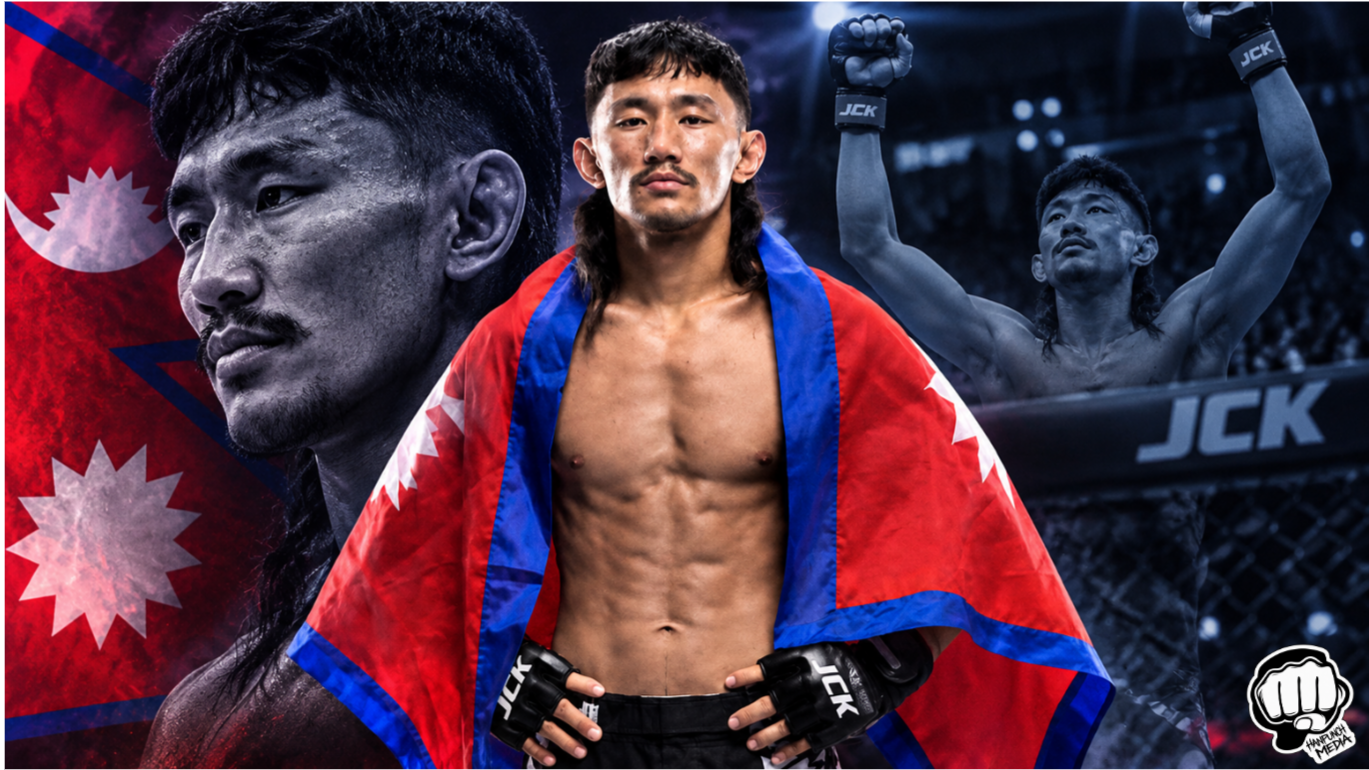
Yuki Angdembe earns unanimous decision at JCK 123
The clearest result reported from JCK 123 came in the bantamweight contest between Yuki “The Gurkha” Angdembe and Buhuogubu. Angdembe entered the fight with an 8 and 3 professional record, while Buhuogubu had 10 wins and seven losses. After 15 minutes, the Nepali fighter secured a unanimous decision victory, with all three judges scoring the contest 30 to 27 in his favour.
The victory moved Angdembe to 9 and 3 professionally and gave him his third consecutive win. For Angdembe, the result continued an impressive 2026 campaign. He had previously defeated Yacub Christ Nugroho at Soma Fight Series and Mandeep Prajapati at Matrix Fight Night 18.
Wrestling makes the difference for Angdembe
The fight initially developed as a striking contest, with both fighters exchanging punches and kicks during the opening stages. Angdembe gradually changed his approach, however, and began relying more heavily on his wrestling. His ability to take the fight to the ground became one of the defining features of the contest.
The Nepali fighter repeatedly secured takedowns and worked from dominant positions. He also looked for submission opportunities while using ground and pound to maintain pressure.
Buhuogubu showed enough defensive ability to avoid an early stoppage and remained in the fight throughout the second round. Angdembe continued to control the grappling exchanges in the third, allowing him to secure the decision on the scorecards. The victory was therefore less about one spectacular moment and more about Angdembe executing a clear game plan over three rounds.
JCK continues to use international matchmaking
One of the most interesting aspects of JCK 123 was the variety of nationalities represented on the card. The lineup included Guoan Zhao vs Uelson de Jesus, a China versus Brazil matchup, as well as Jeong Yun Choi vs Oksana Pavlovskaya, featuring fighters from South Korea and Russia.
Other international matchups included Amir Hossein Alipour vs Dias Otegen, representing Iran and Kazakhstan, and Yuka Okutomi vs Yoo Jin Shin, a Japan versus South Korea contest. Yu Gao also faced Bulgaria’s Aleksandra Toncheva.
This approach gives JCK an opportunity to expose Chinese fighters to different styles while providing international athletes with opportunities to compete in the Chinese market.
Chinese prospects continue to develop
JCK’s official preview also highlighted the depth of its bantamweight division. Mingquan Xia, who entered the event ranked fifth in the JCK bantamweight rankings, was identified as one of the fighters to watch. The promotion highlighted his Brazilian jiu jitsu background and his ability to combine striking with his grappling game.
That kind of matchmaking reflects the broader development of Chinese MMA. Fighters are increasingly being tested across multiple disciplines rather than being developed around a single area of expertise. For prospects hoping to move into larger Asian or international promotions, that experience can prove valuable.
Champions League provides another domestic platform
While JCK 123 was taking place in Lüliang, the Happy Elephant Champions League held its own event in Nanjing.
Unlike JCK’s internationally focused matchmaking, the Champions League card was primarily made up of Chinese fighters. The lineup included Chunsong Chen vs Tingyang Wang, Yesibosen Duishan vs Guanlin Zeng, Zuliyaer Niyazimaimaiti vs Xiao Ma and Meichuan Wang vs Qiangbadanzeng.
The presence of two professional MMA events in China on the same day is notable. It shows that fighters have multiple domestic platforms through which they can gain experience rather than relying on one organization to develop the country’s entire talent pool.
China’s MMA ecosystem continues to expand
China remains one of the world’s largest potential markets for MMA. The country has a long martial arts tradition and a large sports audience, but developing a sustainable professional MMA ecosystem requires regular competition and opportunities for domestic athletes.
Promotions such as JCK and the Champions League contribute to that process by providing fighters with consistent competition inside China. JCK’s international matchmaking adds another layer by allowing Chinese athletes to face opponents with different technical backgrounds.
That international exposure could become particularly valuable as Asian MMA becomes more interconnected.
Japan has RIZIN, DEEP and Pancrase. South Korea has organizations such as Road FC and Black Combat. ONE Championship remains a major force across Asia, while Central Asia has promotions such as Naiza. India also has a developing regional scene, including Matrix Fight Night.
Follow HanPunch for the latest MMA news, exclusive fighter interviews, event coverage, and the stories shaping combat sports around the world.
About The Author


Join the Conversation