

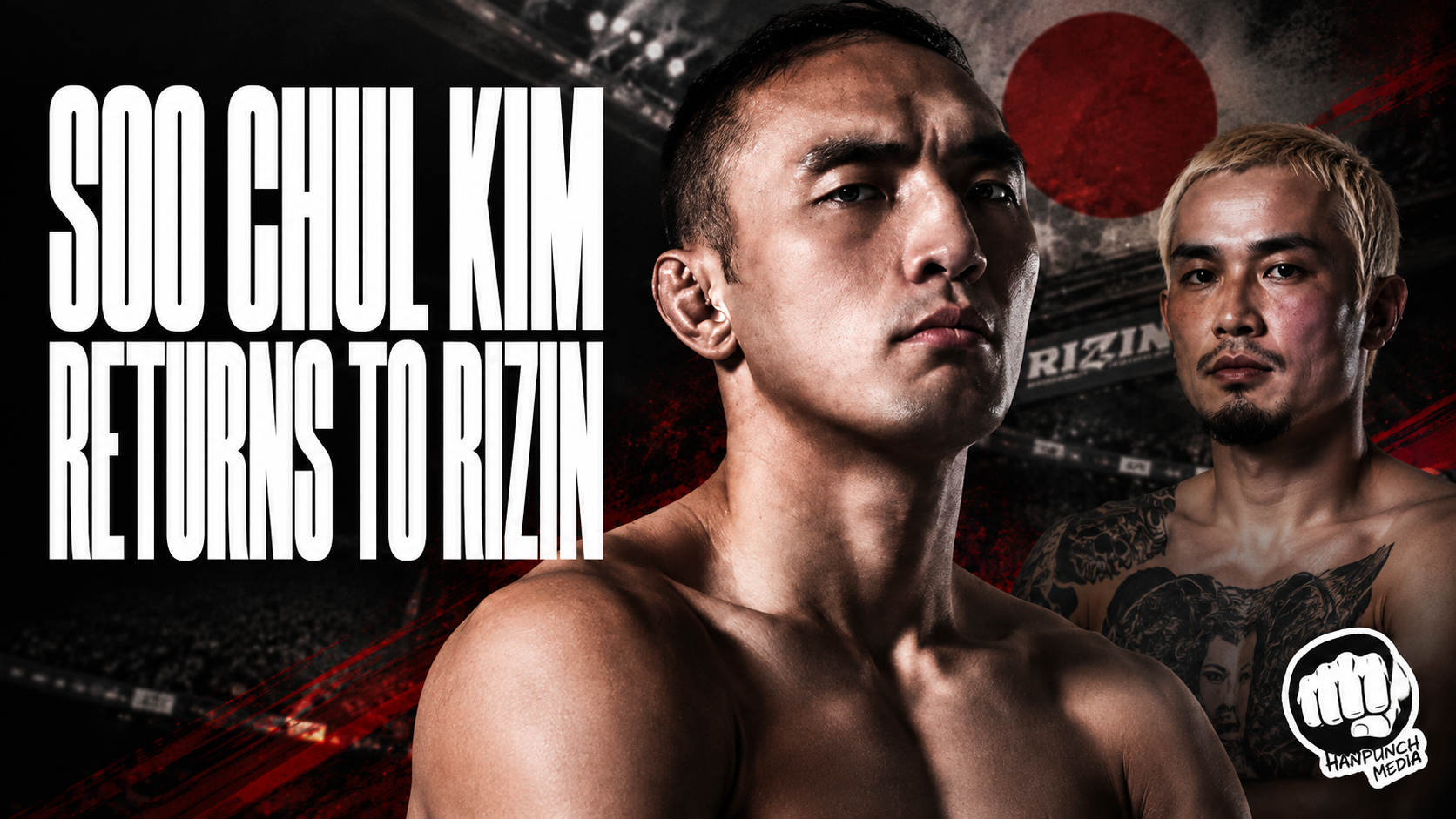
The decorated Korean veteran meets DEEP champion Ryuya Fukuda in a 61-kilogram showdown between two of Asian MMA’s most experienced bantamweights.
Soo Chul Kim has spent much of his career fighting some of the best talent Asia has had to offer. On November 8, another name gets added to that list.
The South Korean veteran will face Japan’s Ryuya Fukuda at RIZIN 55 at LaLa arena TOKYO-BAY in Funabashi, Chiba. RIZIN has officially announced the matchup as a three-round fight contested at 61 kilograms, with each round scheduled for five minutes.
It is the kind of matchup that feels almost tailor-made for Kim.
Across more than a decade in professional MMA, the Korean has built his reputation around pressure, pace and an almost exhausting refusal to give his opponents room to settle.
Fukuda, however, presents exactly the kind of danger that can make that approach complicated.
This is pressure against power.
And for Kim, it represents another major Korean-Japanese matchup on one of Asian MMA’s biggest stages.
Soo Chul Kim’s Long Road Through Asian MMA
At 24-9-1, Kim has already put together a career that stretches across multiple generations of Asian MMA.
He became the inaugural ONE bantamweight champion early in his career and later established himself as one of ROAD FC’s most accomplished fighters, capturing championships at both bantamweight and featherweight.
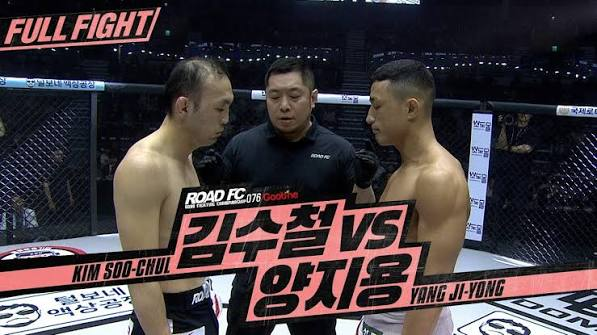
His career has also taken him repeatedly to Japan.
That experience matters.
Soo Chul Kim doesn’t fight like someone looking for a perfect opening. His effectiveness often comes from creating enough activity that openings eventually appear.
He pressures forward, forces opponents to work, mixes his striking with takedown attempts and scrambles, and is willing to turn a technically clean fight into something much less comfortable.
Against Fukuda, that may be especially important.
Ryuya Fukuda Has the Power to Change Everything
Fukuda enters the matchup with considerably more than home-field familiarity.
The Japanese veteran brings a 26-10-1 professional record and championship experience of his own, having captured titles in both DEEP and Shooto.
More importantly for this particular matchup, Fukuda can punch.
Thirteen of his 26 professional victories have come by knockout or TKO, giving Kim a very different problem from an opponent simply trying to match his pace.
Fukuda doesn’t necessarily need to win every minute of the fight if he can create the right exchange.
That is what makes Kim’s forward pressure both his greatest weapon and potentially his biggest risk on November 8.
Every time Kim closes the distance, Fukuda gets an opportunity to time him coming in.
Pressure vs. Power
The tactical battle could begin with a simple question: who gets to decide the distance?
Soo Chul Kim should have little interest in allowing Fukuda to establish a comfortable striking rhythm in open space.
Expect the Korean veteran to pressure.
That doesn’t necessarily mean immediately shooting for takedowns. Kim’s ability to blend phases is part of what makes him difficult to deal with. He can box his way forward, force an opponent backward and then transition into wrestling once the distance collapses.
Against a dangerous puncher, those exchanges become especially important.
If Kim can force Fukuda toward the ropes and make him defend takedowns, clinches and repeated entries, he can begin turning the fight into the kind of physically demanding contest he has built his career around.
Fukuda’s job is almost the opposite.
He needs space.
If he can maintain enough distance to read Kim’s entries, his timing and punching power could make the Korean pay for coming forward too aggressively.
Kim may be the fighter creating the pressure, but Fukuda could be the fighter waiting for the mistake.
The Grappling Question
The biggest strategic advantage available to Kim may be his ability to change where the fight takes place.
If the striking exchanges become dangerous, Kim doesn’t have to remain there.
His wrestling and grappling give him another route into the fight, particularly if he can turn Fukuda’s attempts to create space into opportunities to close distance.
That doesn’t mean Fukuda needs to dominate the grappling exchanges himself.
He may simply need to survive them.
If Fukuda can repeatedly separate, return the fight to open space and force Kim to begin the process again, the accumulated effort required to wrestle could become increasingly important as the fight progresses.
RIZIN has confirmed the matchup will be fought over three five-minute rounds at 61 kilograms.
Fifteen minutes gives both men enough time to impose their preferred style, but not much room to surrender an entire round while waiting for the fight to develop.
Another Japan Test for Kim
There is also a larger storyline surrounding Kim’s return.
His career has become intertwined with the broader rivalry between Korean and Japanese MMA.
Kim has fought across several of Asia’s most significant promotions and competed against elite opposition from both countries. Fukuda represents another established Japanese champion standing across from him.
This isn’t a developing prospect being thrown into a major international opportunity.
Both men have already been champions.
Both have been through long professional careers.
And both understand exactly what a fight like this can mean.
RIZIN 55 takes place Sunday, November 8, with the promotion currently listing a scheduled 2 p.m. local start at LaLa arena TOKYO-BAY.
For Kim, there isn’t much left to prove about whether he belongs among the notable Korean fighters of his generation.
November 8 is about something different.
It is another chance to walk into Japan, stand across from one of the country’s established champions, and see whether the relentless style that has defined Soo Chul Kim’s career can still force another high-level opponent to fight his fight.
Follow HanPunch for the latest Korean MMA news, exclusive fighter interviews, event coverage, and the stories shaping combat sports across Asia.
About The Author



Join the Conversation