

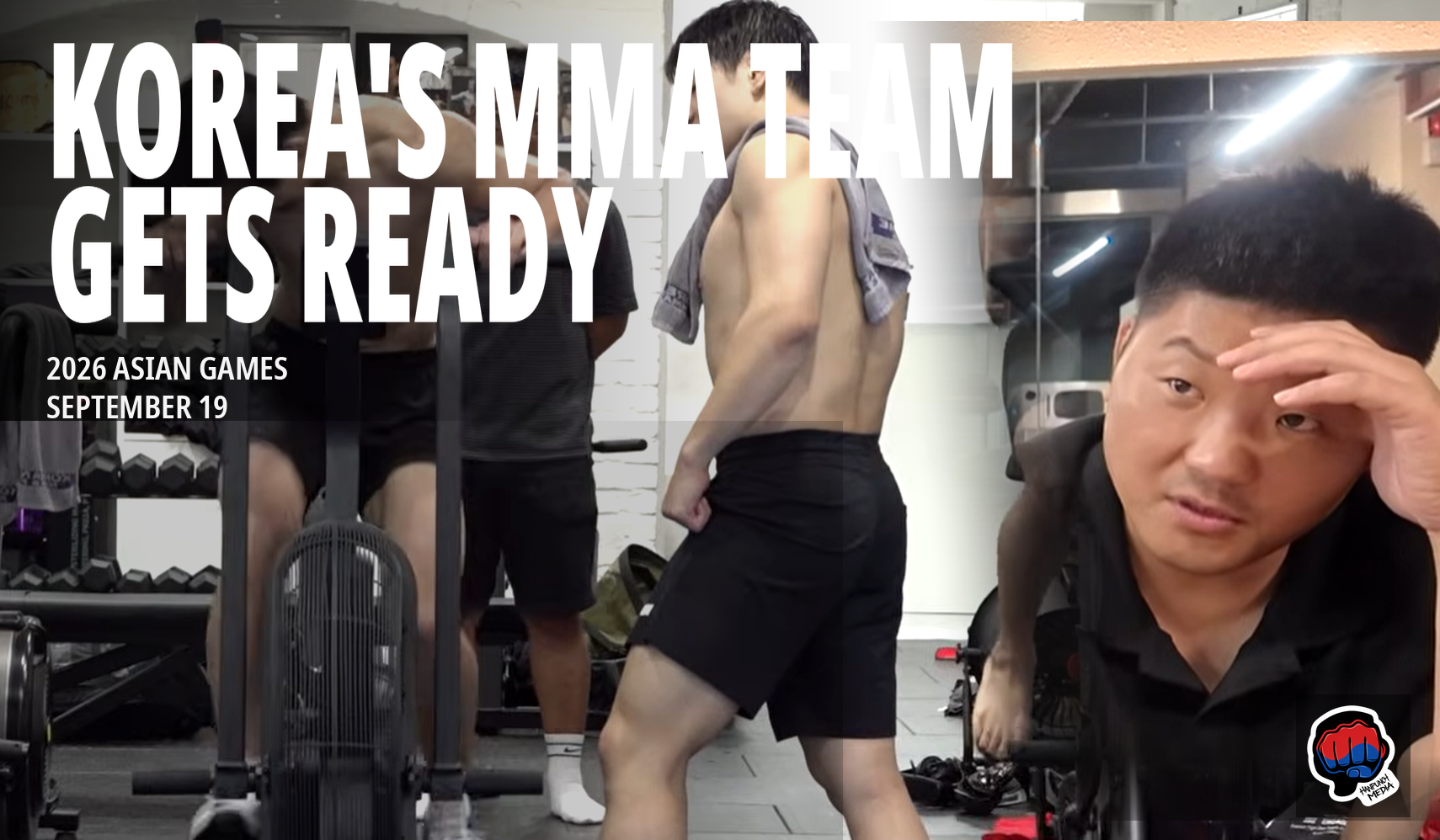
With MMA set for its Asian Games debut, South Korea’s national team is traveling between gyms, searching for tougher training partners and managing the physical demands of camp as Aichi-Nagoya approaches.
The 2026 Asian Games are getting closer, and South Korea’s MMA national team is deep into preparations for the sport’s debut on the Asian Games stage.
In a recent behind-the-scenes video from head coach A Sol Kwon, filmed when 55 days remained before competition, viewers get a revealing look at what Korea’s preparation actually looks like.
It isn’t taking place inside one centralized training room.
Kwon and his fighters have been moving between gyms, cities and training partners in search of the specific looks they need. That has taken members of the team from Jeju to Seoul and into some of Korea’s established MMA rooms, including Korean Zombie MMA.
The strategy appears to be working.
But as the September 19 competition approaches, the footage also shows another side of camp: injuries are beginning to accumulate, workloads are increasing and the coaching staff is balancing the need for improvement against the need to arrive at the Asian Games healthy.
From Jeju to Seoul in Search of Better Rounds
One of the most revealing comments comes before the team even arrives at Korean Zombie MMA.
After previously spending much of his training in Jeju, one of the fighters admits that working repeatedly with a limited group of partners made it difficult to recognize some of the holes in his game.
Seoul has changed that.
Different gyms mean different bodies, styles and problems.
He’s getting submitted more.
He’s getting hit more.
And he believes he’s becoming a better fighter because of it.
The experience has already forced him to make adjustments to his style, while giving him access to training partners specifically suited to areas he needs to improve.
For Kwon’s national team, that appears to be an important part of the current camp.
Instead of keeping every athlete under one roof, they’re going where the appropriate training is available.
On this particular day, that means Korean Zombie MMA.
Injuries Begin to Complicate the Camp
The benefits of that workload come with a cost.
Hyun Seok Choi had recently returned to Seoul after injuring his ankle during a previous training session at Songtan MMA.
According to the team, Choi rolled the ankle during a standing exchange and spent approximately a week back in Jeonju receiving physical therapy and allowing it to recover.
By the time of the Korean Zombie MMA session, he was back.
But he wasn’t necessarily back to 100 percent.
During the later coaching discussion, the ankle is mentioned again as something affecting Choi’s ability to move at moments when his footwork would normally be required.
And he isn’t the only fighter feeling the effects of camp.
The coaches acknowledge that smaller injuries have started appearing across the team as the training volume has increased.
That’s becoming another part of Kwon’s job.
There is still plenty that needs improvement.
There is increasingly less time to improve it.
And every hard session now has to be weighed against the possibility of losing valuable training time to injury.
How Much Training Is Too Much?
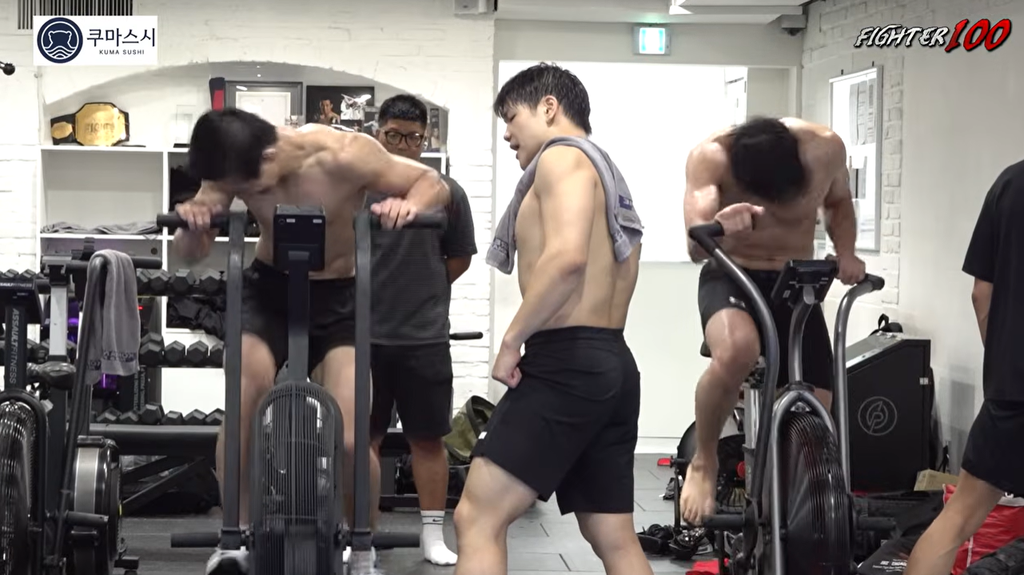
At one point, Kwon asks how the team’s current workload compares with that of normal professional fighters.
The response says plenty about the intensity of the camp.
There isn’t much more they can do.
A typical day can include morning weight training and Jiu-Jitsu, afternoon fighter practice and another training session at a different gym in the evening.
Then they wake up and do it again.
During the heavier portions of the week, that can mean three separate sessions in a day.
The discussion eventually turns toward recovery.
Earlier in the camp, the end of the week had offered a lighter schedule. But by the time this footage was recorded, Friday and Saturday were increasingly being used for training as well, leaving Sunday as the primary day off.
The question is no longer simply whether the athletes are training hard enough.
It’s whether the team can continue pushing that pace while keeping everyone healthy enough to compete.
A Sol Kwon Isn’t Trying to Fix Everything
Despite the workload, Kwon’s technical philosophy appears relatively simple.
There isn’t enough time to rebuild every fighter.
So fix the problems that can lose them fights.
During the grappling portion of the session, Kwon makes one priority particularly clear.
If his fighters are taken down, he wants them back on their feet.
Immediately.
He’s less concerned with style than the result. Instead of allowing an opponent to settle into top position and burn valuable time, the athletes work on using their hips to create space, building a base and transitioning back to standing.
The same philosophy applies elsewhere.
Identify the bad habits.
Remove them as quickly as possible.
Then move on to the next problem.
With competition approaching, practical improvement matters more than technical perfection.
Bo Mi Lee’s Focus Turns to Fundamentals
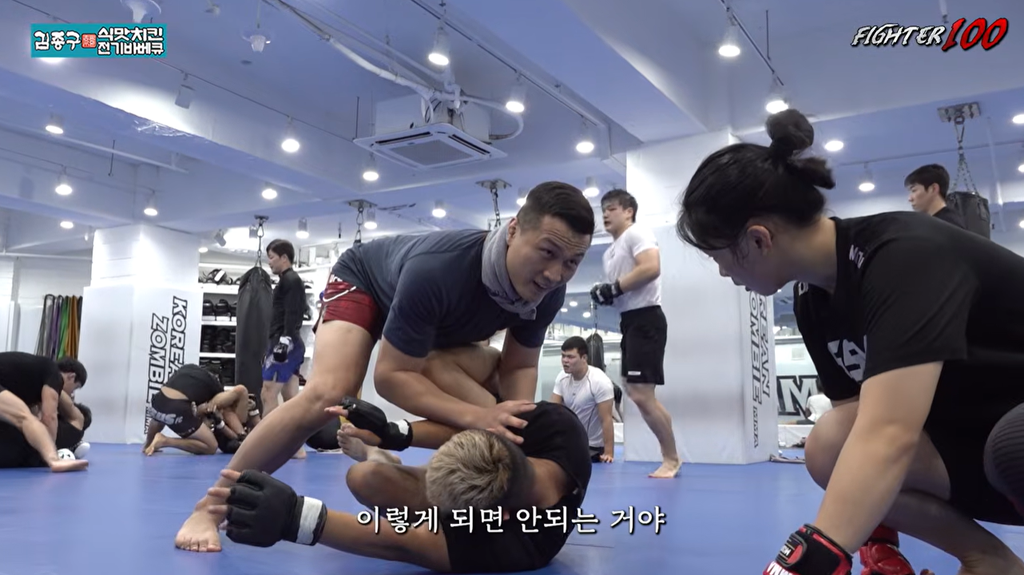
Bo Mi Lee presents the coaching staff with a different challenge.
Physically, they’re pleased with where she is.
Her conditioning and strength are described as strong.
The area requiring attention is her technical foundation.
Rather than adding more complexity to Lee’s game, the coaches are investing time in fundamentals they believe still need development.
It reinforces one of the challenges facing Kwon throughout this camp.
Preparing a national team doesn’t mean giving every athlete the same training program.
One fighter needs different sparring partners.
Another needs defensive wrestling.
Another needs technical fundamentals.
Another may simply need time to recover.
The coaching staff has to determine what will produce the biggest improvement for each athlete before the Asian Games arrive.
Korea’s MMA Community Becomes Part of the Camp
Perhaps the most interesting aspect of the footage is how decentralized Korea’s preparation has become.
MMA has always been built around individual gyms and teams.
Kwon’s Asian Games camp is reaching beyond those boundaries.
The fighters are traveling between different gyms and working with coaches and athletes outside their normal circles when the situation calls for it.
Korean Zombie MMA is one stop in that process.
For fighters accustomed to familiar training partners, those visits provide something valuable: discomfort.
They aren’t supposed to win every round.
Getting submitted can reveal a hole.
Getting caught with a punch can expose a bad habit.
Struggling to get back to the feet can show exactly what needs to be drilled next.
At this stage of camp, finding those problems is part of the preparation.
The important part is fixing them before September 19.
The Countdown Has Changed
Kwon’s video captured the national team at D-55.
That moment has already passed.
What viewers were watching was a snapshot of Korea’s preparation at a point when there was still enough time to experiment — enough time to travel to another gym, change a training routine, correct a weakness or give an injured ankle a week to recover.
Now the margin is getting smaller.
The Asian Games MMA competition begins September 19, and every week that passes changes the calculation.
Hard training still matters.
So does recovery.
Technical improvement matters.
So does knowing when not to change a fighter.
For A Sol Kwon and South Korea’s MMA national team, those decisions are becoming increasingly important as the sport’s Asian Games debut approaches.
The D-55 footage showed a team still searching for weaknesses.
What matters now is how many of those weaknesses Korea can turn into strengths before September 19.
Follow HanPunch for the latest Korean MMA news, exclusive fighter interviews, event coverage, and the stories shaping combat sports across Asia.
About The Author





Join the Conversation